
For many homeowners, the refrigerator filter feels like the obvious first line of defense. It is already built into the fridge, it makes water taste better, and it is easy to use.
But if you are an Iowa homeowner concerned about nitrates, a standard refrigerator filter may not be enough.
Most fridge filters are designed primarily to improve taste, odor, and certain contaminants like chlorine or lead depending on the model. Nitrates are different. They are dissolved in water, and reducing them usually requires a more specialized treatment method.
Why This Matters in Iowa
Nitrates are one of the most important drinking water concerns in Iowa. They are commonly associated with fertilizer, manure, wastewater, and agricultural runoff. Because Iowa has a large agricultural landscape, nitrates can enter rivers, groundwater, and private wells.
The federal drinking water limit for nitrate is 10 mg/L as nitrogen, according to the U.S. Environmental Protection Agency.
Iowa State University Extension also states that water with nitrate concentrations of 10 mg/L or higher should not be consumed by infants under 6 months of age or pregnant women.
That is why more Iowa families are asking a specific question:
Does my current filter actually reduce nitrates?
What Refrigerator Filters Usually Do Well
Most refrigerator filters use activated carbon filtration. Activated carbon is helpful for improving taste and reducing chlorine-related odor. Many fridge filters may also reduce certain contaminants depending on their certification and filter design.
For everyday taste improvement, a fridge filter can be useful.
It may help with:
- Chlorine taste and odor
- Some sediment or particles
- Certain metals or contaminants, depending on the filter
- Better-tasting cold water and ice
The issue is that better taste does not always mean nitrate reduction.
Nitrate does not usually create a noticeable taste, smell, or color in water. So water can taste clean and still contain nitrates.
Do Fridge Filters Remove Nitrates?
In most cases, standard refrigerator filters are not designed to remove nitrates.
To know for sure, you have to check the filter’s certification and performance data sheet. If nitrate reduction is not specifically listed, homeowners should not assume the filter removes nitrates.
This is especially important because nitrate is not the same as chlorine, sediment, or odor. It is a dissolved ion, and reducing it typically requires treatment technologies such as reverse osmosis, distillation, or anion exchange. Iowa State University Extension identifies reverse osmosis, distillation, and anion exchange as home treatment systems that can remove nitrate from drinking water.
Why Reverse Osmosis Is Different
Reverse osmosis uses a semi-permeable membrane to help reduce dissolved contaminants before water reaches a dedicated drinking water faucet.
That membrane is what makes RO different from many basic carbon filters. Instead of only improving taste and odor, reverse osmosis is designed to reduce a broader range of dissolved substances.
For Iowa homeowners, that matters because reverse osmosis is one of the practical point-of-use options for reducing nitrates in drinking water.
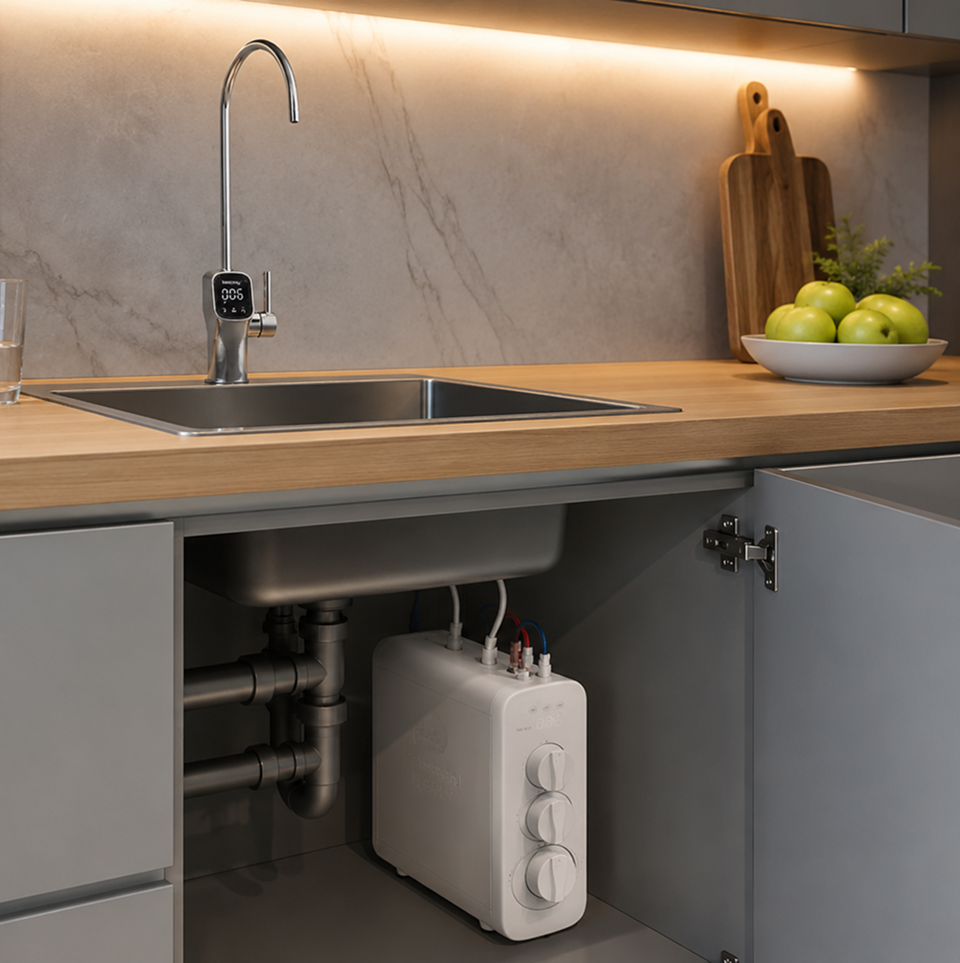
An under-sink RO system is typically installed below the kitchen sink and connected to a dedicated faucet. It treats the water used most often for:
- Drinking
- Cooking
- Coffee and tea
- Baby formula
- Pet water
- Daily kitchen use
Fridge Filter vs. Reverse Osmosis
| Category | Standard Fridge Filter | Under-Sink Reverse Osmosis |
|---|---|---|
| Main Purpose | Taste, odor, and basic filtration | Higher-level drinking water filtration |
| Nitrate Reduction | Usually not unless specifically certified for it | RO is identified as a treatment method for nitrate removal |
| Filtration Type | Typically activated carbon | Multi-stage filtration with RO membrane |
| Best Use | Cold water and ice taste improvement | Drinking, cooking, coffee, pets, and daily use |
| Installation | Built into refrigerator | Installed under kitchen sink |
| Long-Term Solution | Limited by fridge/filter design | Dedicated point-of-use drinking water system |
How to Check Your Current Fridge Filter
If you want to know whether your refrigerator filter reduces nitrates, look for the product’s performance data sheet or certification listing.
Search for:
- The exact filter model number
- NSF/ANSI certification information
- Contaminant reduction claims
- The word “nitrate” specifically
NSF maintains a searchable certification database for drinking water treatment products. Homeowners can search by manufacturer, brand, or model to verify what a filter is certified to reduce.
If nitrate is not listed, it is safer to assume the filter is not designed for nitrate reduction.
The Bottom Line
A refrigerator filter can make water taste better, but that does not mean it is reducing nitrates.
For Iowa homeowners concerned about nitrate exposure, a standard fridge filter is usually not the right long-term solution unless the specific filter is certified for nitrate reduction. Reverse osmosis, on the other hand, is widely recognized as a point-of-use treatment method for reducing nitrates in drinking water.
If your main concern is taste, a fridge filter may be enough. If your main concern is nitrates, an under-sink reverse osmosis system is likely the stronger solution.