Understanding Iowa’s Drinking Water Challenges
From nitrates and agricultural runoff to private wells and aging infrastructure, Iowa homeowners are paying closer attention to what is in the water they drink every day.
Iowa Water Quality by the Numbers
Iowa’s water quality concerns are not abstract. Recent reports and public data show elevated nitrate levels in major Central Iowa source waters and a large number of impaired water bodies across the state.
10 mg/L
Federal drinking water limit for nitrate as nitrogen. Iowa utilities must treat finished drinking water to stay within this standard.
20.55 mg/L
Reported 2025 nitrate peak in the Raccoon River, according to Des Moines Water Works.
17.15 mg/L
Reported 2025 nitrate peak in the Des Moines River, according to Des Moines Water Works.
#2 In Cancer Rates
Iowa has the 2nd highest rate of new cancer cases in the U.S. according to the National Cancer Institute and CDC.

Source
Des Moines Water Works reported 2025 nitrate peaks of 20.55 mg/L in the Raccoon River, 17.15 mg/L in the Des Moines River, and 12.14 mg/L in its infiltration gallery, with all three sources above the 10 mg/L standard for more than 30 days in June and July. Iowa DNR’s 2024 impaired waters list included 577 water bodies with 746 impairments.
Why Iowa Water Quality Is Getting More Attention
Iowa’s water quality concerns are closely tied to the state’s agricultural landscape. Nitrate pollution is commonly associated with fertilizer, manure, wastewater, and runoff moving through fields, tile drainage, groundwater, rivers, and watersheds.
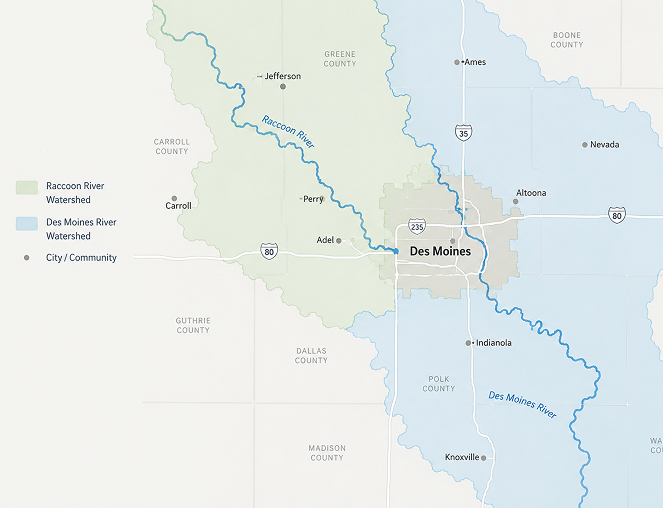
In agricultural states like Iowa, these issues can become especially visible when nitrate levels rise in major drinking water sources. For Central Iowa, the Raccoon River and Des Moines River are especially important because they help supply drinking water for the Des Moines metro and surrounding communities.
When nitrate levels rise in these source waters, water utilities must work harder to treat the water and keep finished drinking water within federal standards.

Fertilizer & Manure

Fields, Soil & Tile Drainage

Streams, Rivers & Groundwater

Drinking Water Sources
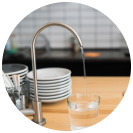
Household Tap Water
Nitrates can move through Iowa’s landscape through runoff, drainage systems, groundwater, and rivers.
This is why water quality is not just a household issue. It is connected to land use, agriculture, infrastructure, and watershed management.
The Raccoon River and Des Moines River Matter
The Raccoon River and Des Moines River play an important role in Central Iowa’s drinking water system. In 2025, elevated nitrate levels in these source waters created treatment capacity challenges and contributed to regional lawn watering restrictions.
Des Moines Water Works reported that nitrate concentrations peaked at 20.55 mg/L in the Raccoon River and 17.15 mg/L in the Des Moines River. Both were well above the federal drinking water limit of 10 mg/L for nitrate as nitrogen.
Public reporting from Iowa Public Radio also showed nitrate readings of 14.17 mg/L in the Raccoon River and 13.9 mg/L in the Des Moines River during June 2025.
These numbers matter because they show how source water quality can create real challenges even when public utilities are working to keep finished drinking water within regulatory limits.
Health Concerns Around Nitrates
Nitrate is not something most homeowners can see, smell, or taste. Water can look clear and still contain elevated nitrate levels, which is why Iowa’s drinking water conversation has become closely tied to long-term health concerns.
The most established health concern is infant health. Iowa State University Extension states that water with nitrate concentrations of 10 mg/L or higher should not be consumed by infants under six months of age or pregnant women.
Iowa’s broader cancer concerns are also getting more attention. The Iowa Cancer Registry reported that Iowa continues to have the second-highest rate of newly diagnosed cancers among U.S. states, after adjusting for age, and the 2026 Cancer in Iowa report estimated 21,700 new cancer diagnoses and 6,400 cancer deaths in Iowa for the year.
Research has also examined possible links between nitrate exposure in drinking water and certain cancers. The University of Iowa Environmental Health Sciences Research Center notes that studies conducted in Iowa have shown positive correlations between nitrate exposure in drinking water and some cancers.
Cancer risk is complex and should not be reduced to one cause. However, Iowa’s elevated cancer incidence, combined with ongoing nitrate concerns, is one reason more families are looking for practical ways to reduce exposure through the water they drink every day.
Beyond Nitrates
Nitrates are a major concern in Iowa, but they are not the only water quality issue homeowners may think about. Depending on the water source, plumbing, and local conditions, drinking water discussions may also include:

Arsenic

Bacteria
PFAS
Lead

Chlorine taste and odor

Sediment
Hardness minerals

Total Dissolved Solids (TDS)
Pesticide or agricultural runoff concerns
Not every filter is designed for every contaminant. That is why it is important to understand what a system is designed to reduce and whether it is appropriate for the problem the homeowner is trying to solve.
Why Common Filters May Not Be Enough
Many households rely on bottled water, refrigerator filters, pitcher filters, or basic carbon filters. These options can improve taste and convenience, but they are not always designed for nitrate reduction.
Nitrate is dissolved in water, which means reducing it typically requires a treatment technology suited for dissolved contaminants. Iowa State University Extension identifies reverse osmosis, distillation, and anion exchange as home treatment options that can remove nitrate from drinking water.
For many homeowners, reverse osmosis is the most practical everyday option because it can be installed under the kitchen sink and used for the water people actually consume most often.
How Reverse Osmosis Helps at the Household Level
Under-sink reverse osmosis is a point-of-use drinking water solution. Instead of treating every gallon of water entering the home, it focuses on the water used most directly for consumption.
That includes:
- Drinking water
- Cooking
- Coffee and tea
- Baby formula
- Pet water
- Everyday kitchen use
Reverse osmosis systems use membrane filtration to help reduce dissolved contaminants before water reaches a dedicated drinking water faucet. For Iowa homeowners concerned about nitrates, this creates a practical long-term solution at the point of use.
A Practical Step While Bigger Solutions Take Time
Iowa’s water quality issues are complex. Long-term improvement will require continued work across agriculture, infrastructure, conservation, utility treatment, public policy, and community education.
At the same time, homeowners do not have to wait to take action inside their own homes.
An under-sink reverse osmosis system gives Iowa families a practical way to reduce nitrates and improve the drinking water they use every day. It is not a replacement for broader water quality reform, but it is a meaningful household-level solution for people who want more confidence at the kitchen sink.
Ready to Improve Your Drinking Water?
Iowa Reverse Osmosis offers three professionally installed under-sink reverse osmosis systems for Iowa homes.