Iowa’s water quality problem has become hard to ignore. Across the state, homeowners are hearing more about nitrates,
agricultural runoff, public water treatment challenges,
private well concerns, and potential long-term health risks.
For many families, the question is simple: what can we actually do inside our own home to improve the water we drink every day?
One of the most practical answers is under-sink reverse osmosis.
What Are Nitrates?
Nitrate is a form of nitrogen that can enter water through fertilizer, manure, wastewater, and natural soil processes.
In agricultural states like Iowa, nitrates are commonly
associated with runoff from farm fields, tile drainage, livestock operations, and watershed systems.
Nitrate itself is not something most homeowners can see, taste, or smell in their water. That is part of what makes the issue concerning.
Water may look completely clear while still containing elevated nitrate levels.
The U.S. Environmental Protection Agency’s legal limit for nitrate in public drinking water is 10 mg/L, a standard designed primarily to protect against “blue baby syndrome,”
a potentially dangerous condition for infants.
Why Iowa Has a Nitrate Problem
Iowa’s nitrate issue is closely tied to the state’s agricultural landscape. Fertilizer and manure are widely used to support crop production,
but nitrogen can move through soil and drainage systems into rivers,
streams, and groundwater.
This is especially relevant in Central Iowa because major water sources like the Raccoon River and Des Moines River collect runoff from large
agricultural watersheds. When nitrate levels rise in those rivers, water utilities must work harder to treat the water before it reaches homes.
In 2025, Central Iowa experienced a major nitrate spike. Iowa Public Radio reported nitrate levels of 14.17 mg/L in the Raccoon River and 13.9 mg/L in the Des Moines River in June,
both above the federal drinking water limit of 10 mg/L.
Des Moines Water Works later reported that nitrate concentrations in 2025 peaked at 20.55 mg/L in the Raccoon River, 17.15 mg/L
in the Des Moines River, and 12.14 mg/L in the infiltration gallery. The utility also reported that all three source waters
stayed above the 10 mg/L drinking water standard for more than 30 days in June and July.
Why the Raccoon River Matters
The Raccoon River is one of Central Iowa’s most important drinking water sources, especially for the Des Moines metro.
When nitrate levels rise in the Raccoon River, it can create real
treatment challenges for the regional water system.
Central Iowa Water Works reported that it had been removing nitrate for more than 50 days during the 2025 nitrate event,
describing nitrate removal as an added step in an already complex process
of producing clean water for roughly 600,000 Central Iowans.
The issue became visible to the public when Central Iowa Water Works implemented lawn watering restrictions to
reduce water demand and preserve treatment capacity. Des Moines Water Works stated that the lawn watering ban was needed because
prolonged elevated nitrate levels were creating treatment capacity challenges.
Health Concerns Around Nitrates
The immediate federal nitrate limit is based largely on protecting infants from blue baby syndrome.
Iowa State University Extension states that water with nitrate concentrations of 10 mg/L or higher should not be consumed by
infants under six months of age or pregnant women.
However, public concern around nitrates has grown beyond infant health. The University of Iowa’s Environmental Health Sciences Research Center states that studies conducted in Iowa have shown positive correlations between nitrate exposure in drinking water and some cancers.
Its fact sheet also notes that the International Agency for Research on Cancer classifies nitrate in food and water as “probably carcinogenic to humans.”
That does not mean every glass of Iowa tap water is unsafe, and it does not mean nitrate exposure alone explains Iowa’s cancer concerns. Cancer risk is complicated and can involve many factors. But it does help explain why more Iowa homeowners
are paying attention to long-term drinking water quality and looking for practical ways to reduce exposure at home.
Why Fridge Filters and Pitcher Filters May Not Be Enough
Many homeowners respond to water concerns by buying bottled water, using a refrigerator filter, or filling a pitcher filter. Those options can help with taste and convenience,
but they are not always designed to address dissolved contaminants like nitrates.
Nitrates are different from things like sediment or chlorine taste.
They are dissolved in the water, which means reducing them requires the right type of treatment technology.
That is where reverse osmosis becomes important.
How Reverse Osmosis Helps
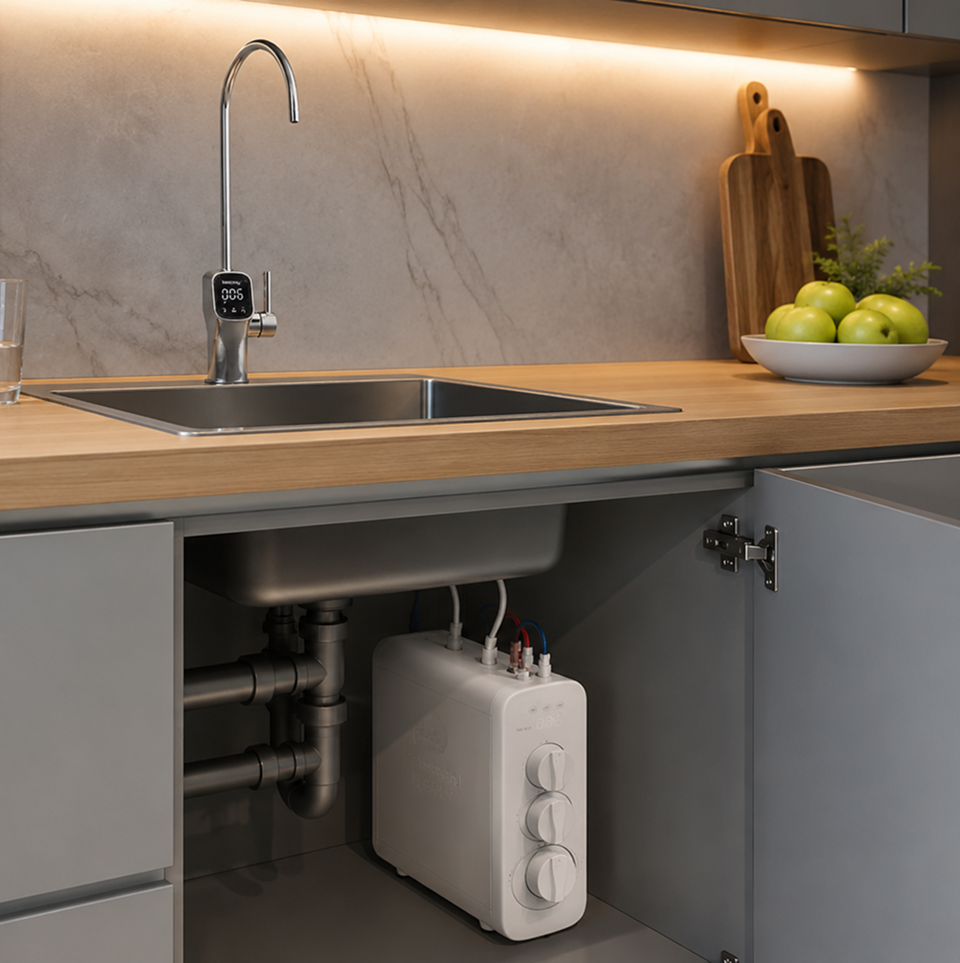
Reverse osmosis is a point-of-use filtration method typically installed under the kitchen sink. It pushes water through a specialized membrane that helps
reduce dissolved contaminants before the water reaches a dedicated drinking water faucet.
Iowa State University Extension identifies reverse osmosis,
distillation, and anion exchange as home treatment options that can remove nitrate from drinking water.
For homeowners, under-sink reverse osmosis is especially practical because it focuses on the water people actually consume most often:
- Drinking water
- Coffee and tea
- Cooking water
- Baby formula
- Pet water
- Daily kitchen use
Instead of treating every gallon of water in the home, an under-sink RO system
targets the water used most directly for drinking and food preparation.
A Long-Term Household Solution
Iowa’s nitrate issue is not likely to disappear overnight. It is tied to agriculture, weather, watershed management, public infrastructure, and long-term environmental conditions. Municipal water systems will continue doing their part to meet drinking water standards,
but many homeowners want an added layer of protection inside the home.
An under-sink reverse osmosis system gives families a more permanent alternative to bottled water, pitcher filters, and short-term fixes.
It provides filtered water directly from the kitchen sink and can help reduce nitrates at the point of use.
For Iowa homeowners concerned about drinking water quality, reverse osmosis is not just a convenience upgrade. It is a practical step
toward taking more control over the water their household uses every day.