
Nitrates have become one of the biggest drinking water concerns for Iowa homeowners. They are commonly associated with fertilizer, manure, and agricultural runoff, and they can enter rivers, groundwater, and private wells.
The difficult part is that nitrates are not something you can see, taste, or smell. Water may look perfectly clean and still contain elevated nitrate levels. That is why choosing the right type of filtration matters.
Not every filter is designed to reduce nitrates.
Why Nitrate Filtration Is Different
Many common home filters are designed mainly for taste and odor. They may reduce chlorine taste, sediment, or certain metals depending on the filter, but nitrate is different.
Nitrate is dissolved in water, which means it usually requires a treatment method specifically suited for dissolved contaminants.
The federal drinking water limit for nitrate is 10 mg/L as nitrogen, a standard originally designed to protect against health risks such as infant methemoglobinemia, also known as blue baby syndrome. Iowa State University Extension identifies reverse osmosis, distillation, and anion exchange as home treatment options that can remove nitrate from drinking water.
That means the “best” water filter for nitrates is not always the one that improves taste the most. It is the one designed and tested for nitrate reduction.
Common Water Filter Options
Pitcher Filters
Pitcher filters are inexpensive and easy to use. They can improve taste and reduce some basic contaminants depending on the model.
However, most standard pitcher filters are not the best choice for nitrate reduction unless the specific filter is certified or clearly rated to reduce nitrates. If nitrate is not listed on the product’s performance data sheet, homeowners should not assume it is being reduced.
Refrigerator Filters
Refrigerator filters are convenient because they are already built into many homes. They can improve taste and make ice and cold water more pleasant.
But like pitcher filters, most standard fridge filters are not primarily designed for nitrate reduction. They may help with chlorine taste, odor, and certain contaminants, but nitrate reduction requires the right technology and certification.
Carbon Filters
Activated carbon filters are common in pitchers, fridge filters, faucet filters, and some whole-home systems. They are useful for taste, odor, and chlorine-related concerns.
Carbon filtration can be very helpful, but carbon alone is generally not the primary solution for nitrates. If the main concern is nitrate reduction, carbon filtration should not be assumed to be enough unless the system specifically lists nitrate reduction performance.
Distillation
Distillation can reduce nitrates by boiling water and collecting the condensed steam. Iowa State University Extension identifies distillation as one home treatment option for nitrate removal.
The downside is that distillation is often slower and less convenient for everyday household use. For many families, it is not as practical as having filtered drinking water available directly from the kitchen sink.
Anion Exchange
Anion exchange is another treatment method that can remove nitrates. It works by exchanging nitrate ions with other ions in the treatment media.
This method can be effective, but it often requires more system-specific design, monitoring, and maintenance. It may make sense in some situations, but it is not always the simplest point-of-use solution for everyday homeowners.
Reverse Osmosis
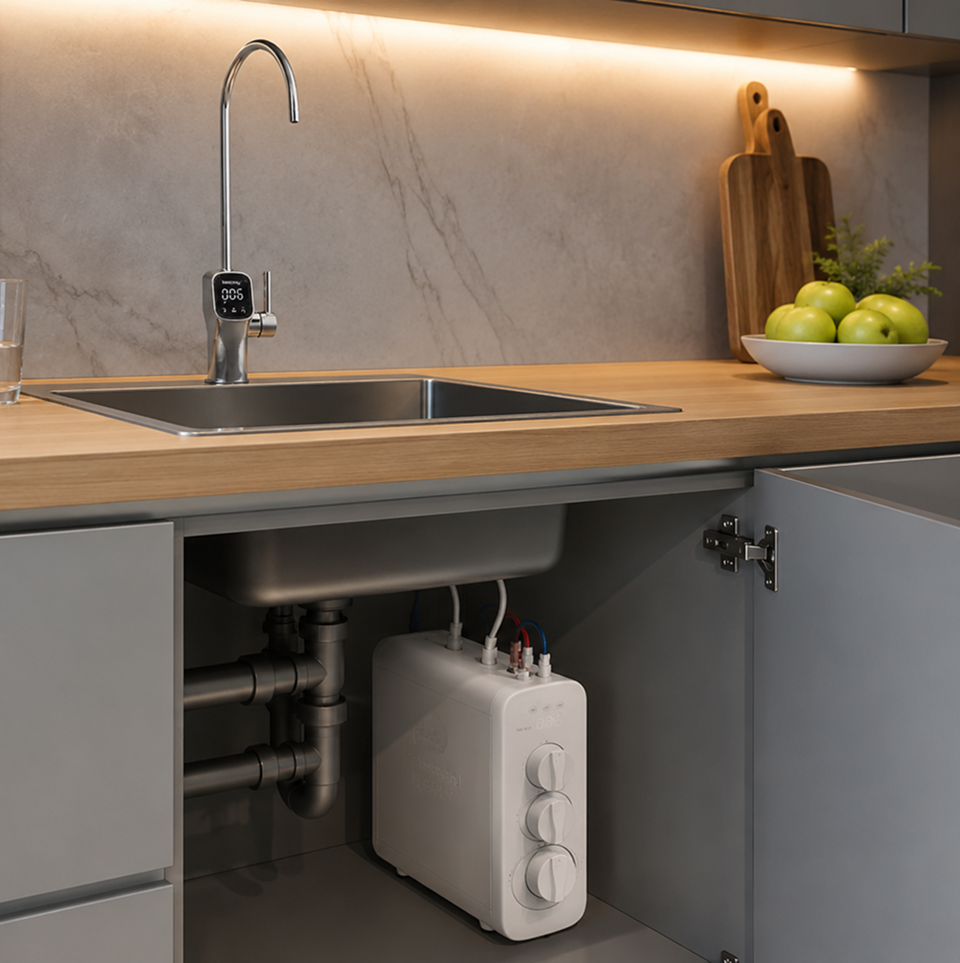
Reverse osmosis is one of the most practical options for nitrate reduction at the kitchen sink. It uses a semi-permeable membrane to help reduce dissolved contaminants before water reaches a dedicated drinking water faucet.
For Iowa homeowners, under-sink reverse osmosis is especially useful because it focuses on the water people consume most often:
- Drinking water
- Cooking water
- Coffee and tea
- Baby formula
- Pet water
- Everyday kitchen use
Instead of treating every gallon of water in the home, an under-sink RO system treats the water most directly connected to daily consumption.
Comparing Nitrate Filter Options
| Filter Type | Good For | Nitrate Reduction? | Everyday Convenience |
|---|---|---|---|
| Pitcher filter | Taste and basic filtration | Usually not unless specifically rated | Moderate |
| Refrigerator filter | Cold water and ice taste | Usually not unless specifically rated | High |
| Carbon filter | Chlorine taste, odor, some contaminants | Not typically the main nitrate solution | High |
| Distillation | Dissolved contaminants, including nitrates | Yes | Lower |
| Anion exchange | Nitrate-specific treatment | Yes | Moderate |
| Reverse osmosis | Drinking water filtration at the tap | Yes | High |
What Iowa Homeowners Should Look For
When comparing systems, homeowners should look for clear information rather than vague claims.
Good signs include:
- Nitrate reduction specifically mentioned
- Third-party testing or certification information
- Reverse osmosis, distillation, or anion exchange technology
- Clear filter replacement schedule
- Transparent installation requirements
- Performance data from the manufacturer
- A system designed for daily drinking water use
If a filter only says it improves “taste” or “odor,” that does not necessarily mean it reduces nitrates.
Why Under-Sink Reverse Osmosis Is Often the Practical Choice
For many Iowa families, under-sink RO offers the best mix of nitrate reduction, convenience, cost, and daily usability.
It does not require buying cases of bottled water. It does not rely on a small pitcher in the fridge. It does not require treating all water throughout the home. Instead, it provides filtered drinking water directly from the kitchen sink.
That makes it a practical long-term solution for homeowners who want to take action without turning the entire house into a water treatment project.
A Smarter Way to Think About Water Filtration
The right filter depends on the problem you are trying to solve.
If your main issue is taste, a fridge filter or pitcher may be enough.
If your issue is hard water, a softener may be the right tool.
But if your concern is nitrates in drinking water, you need a system designed for nitrate reduction.
For many Iowa homeowners, that makes under-sink reverse osmosis one of the clearest and most practical options.